
Home / Is it allowed? / Potted plants
Can I have potted plants in Zone 0?
Updated November 19, 2026
Allowed, with limitsThis answer follows the Board of Forestry's Zone 0 rule as revised on November 5, 2026, which is not in force yet. Some items are already law, and some cities have their own rules. If so, it says so below.
Potted plants can stay in Zone 0, the first 5 feet around a house, with limits. Under the proposed Board of Forestry rule, each pot must be one that doesn't burn (clay, ceramic, concrete or metal), hold 5 gallons or less, stand 2 feet from the next and stay out of the clear strips next to the house. Plants must be soft-stemmed and 18 inches tall or less. Check your pots against the table below.
Where can the pots go?
These strips stay clear of plants, pots included:
- Along the walls: 1 foot, or out to the edge of the eaves (the part of the roof that hangs past the wall) if they reach farther.
- Around windows, doors and vents: 2 feet.
- Around an attached deck, stairs or pergola (an open roof frame): 5 feet, so no pots on the ground beside a deck.
See a drawing of the strips from above. Pots on a concrete or paver patio follow the same limits, since the rule text doesn't count such a patio as part of the house. For pots on top of a deck, the rule does not say. It also does not say how to measure the 2 feet; our reading is rim to rim.
Which pots count?
- Yes, they don't burn: clay (terracotta), glazed ceramic, concrete, stone and metal.
- No: plastic and wood, which the rule names. Our reading: resin, fiberglass and fabric grow bags burn too, so no.
- Loose, not built in: a planter fixed to the wall doesn't count as a pot. Our reading: neither does one sunk into the ground.
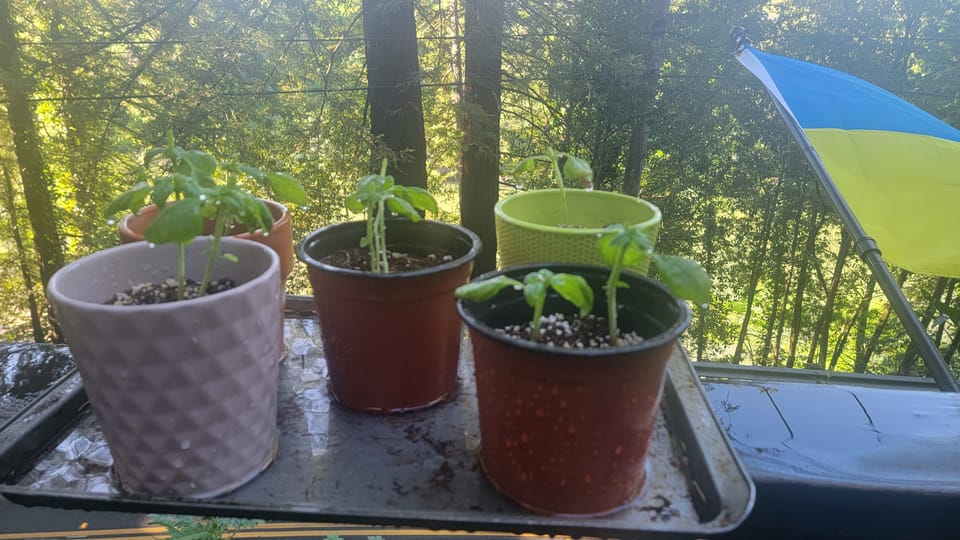
In the photo at the top, only the white ceramic pot would count.
How big is a 5-gallon pot?
A pot 12 inches across with straight sides holds 5 gallons at about 10 inches deep. Measure your pot across the top, inside the rim. If it is deeper than the number below, it holds more than 5 gallons.
| Width across the top | Straight sides | Sides that taper |
|---|---|---|
| 10 inches | 14½ in | 19 in |
| 12 inches | 10 in | 13 in |
| 14 inches | 7½ in | 9½ in |
| 16 inches | 5½ in | 7½ in |
Our calculation from National Institute of Standards and Technology (NIST) unit factors (1 gallon is 231 cubic inches). Method: the volume of a round pot, solved for 5 gallons and rounded down to the half inch; a tapered pot is taken as 3/4 as wide at the bottom as at the top.
Which plants can go in them?
Soft-stemmed plants up to 18 inches tall, measured from the base of the plant, with nothing dead or dying: herbs like basil, annual flowers, bulbs, ferns and succulents. Plants with hard, woody stems that last year to year don't qualify. Our reading: a potted lemon tree, rosemary or small shrub can't stay in Zone 0.
What does Wildfire Prepared Home allow?
Wildfire Prepared Home is a designation from the Insurance Institute for Business and Home Safety (IBHS). It allows up to 10 potted plants in the first 5 feet, in clay, ceramic or other pots that don't burn, each under 36 inches tall counting the pot (IBHS checklist). Bring them indoors during Red Flag Warnings (fire weather alerts from the National Weather Service) and long trips. It also bans planter boxes and woody plants on decks and patios.
Our take: to meet both the proposed rule and Wildfire Prepared Home, follow these limits: 5 gallons or less, 2 feet apart, out of the strips, no more than 10 (the proposed rule sets no count), and indoors on Red Flag days.
Insurers and the IBHS standard can ask for more than the Board of Forestry rule. See how they differ.
Timing: Once the Board of Forestry rule takes effect, existing homes get 3 to 5 years, on a schedule set by CAL FIRE or the local fire agency. New homes must meet it right away.
Source
- Revised Zone 0 rule text, November 5, 2026, California Board of Forestry and Fire Protection, November 5, 2026
- Wildfire Prepared Home: How-To Prepare Checklist, Insurance Institute for Business and Home Safety, checked November 19, 2026
- NIST Guide to the SI, Appendix B.9: conversion factors (volume), National Institute of Standards and Technology, checked November 19, 2026
Related questions
- Can I have bark mulch in Zone 0?
- Is gravel allowed in Zone 0?
- Can I store firewood next to my house?
- Are leaves and pine needles allowed in Zone 0?
Photos by Devan Hemmings unless noted.
Corrections
- October 29, 2026. The timing line gave only the schedule for Local Responsibility Areas (3 years, or up to 5). In a State Responsibility Area (where CAL FIRE is responsible for wildfires), the Board of Forestry's Zone 0 rule gives existing homes 5 years, or a CAL FIRE schedule of at least 3. It now says 3 to 5 years.