
Home / Is it allowed? / Firewood
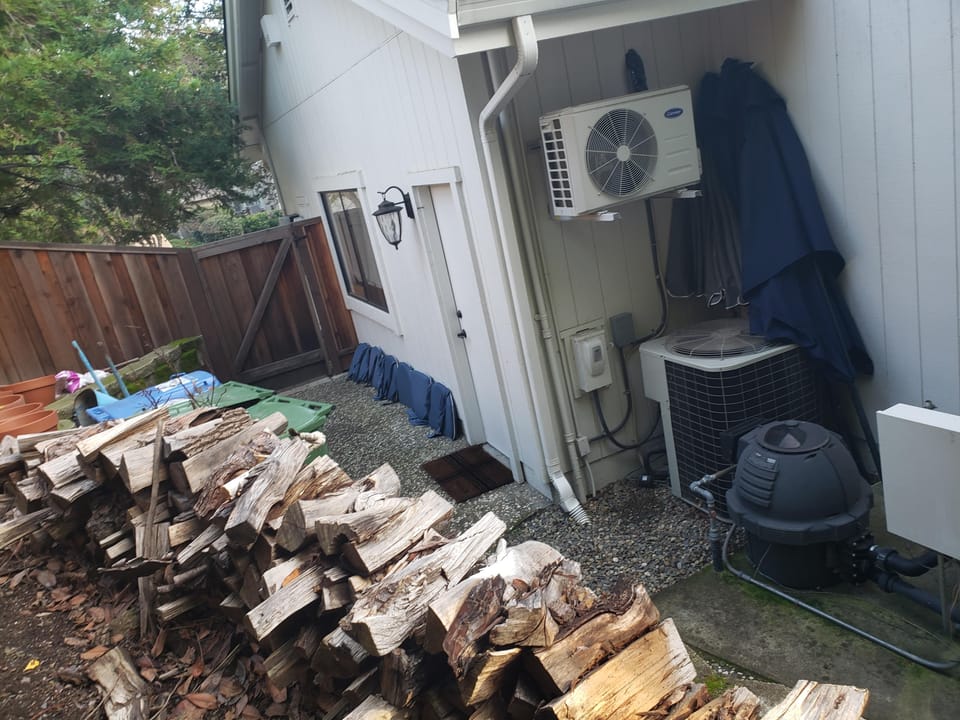
Can I store firewood next to my house?
Updated November 7, 2026
Not allowed, already lawThis answer follows the Board of Forestry's Zone 0 rule as revised on November 5, 2026, which is not in force yet. Some items are already law, and some cities have their own rules. If so, it says so below.
That handy stack by the back door is the problem. In federal fire tests in strong wind, a burning woodpile set 3 to 24 feet from a small building lit the mulch at its base, and fire reached the wall every time. So no. Where California's defensible space law applies, firewood already has to be at least 30 feet from the house unless it is fully covered. The Board of Forestry's Zone 0 rule for the first 5 feet, not in force yet, would ban it there outright.
Already state law
State law already keeps firewood out of the first 30 feet, unless it is fully covered with fire-resistant material. It comes from Zone 1 of the defensible space law, the first 30 feet around a building. That law applies now to every building in a State Responsibility Area (SRA), mostly rural land where CAL FIRE handles wildfire, in any fire hazard zone. In Local Responsibility Areas it applies in Very High fire hazard zones. Fire inspectors check it now. Source: PRC 4291, 14 CCR 1299.03
- Zone 0 is the first 5 feet out from the house, or up to the property line if that is closer.
- Why it matters: embers are burning bits of wood and bark that wind carries ahead of a wildfire. They can land in a woodpile and light it. Then the pile throws its own embers at the house.
- In the chart below, each bar is one distance that NIST, the federal standards lab, tested. Every bar is full: fire reached the wall every time, even at 24 feet. All of those distances are closer than 30 feet.
What happened when NIST burned woodpiles
NIST burned 62 test woodpiles of oak, maple and pine. A big fan pushed a 13 to 31 mph wind across each pile. In 61 tests it blew toward a small wooden shed with a strip of mulch at its base, like the mulch beds next to many homes. Here is what happened:
- Fire reached the wall every time. In all 61 tests with a shed, embers from the pile lit the mulch, and the fire spread to the shed wall.
- It was fast. In 22 to 31 mph wind, embers usually started a fire in under 3 minutes, and flames reached the wall in under 5.
- A few more feet did not help much. Except in the lightest wind tested (13 mph), a pile 24 feet away lit fires about as fast as one 6 feet away.
- Racks and wood type made little difference. Oak, maple and pine, on a rack or on the ground, all burned fast. In wind over 16 mph, the small differences went away.
- The test piles were small. 16 inches deep, stacked either 4 feet tall and 2 feet long, or 2 feet tall and 4 feet long.
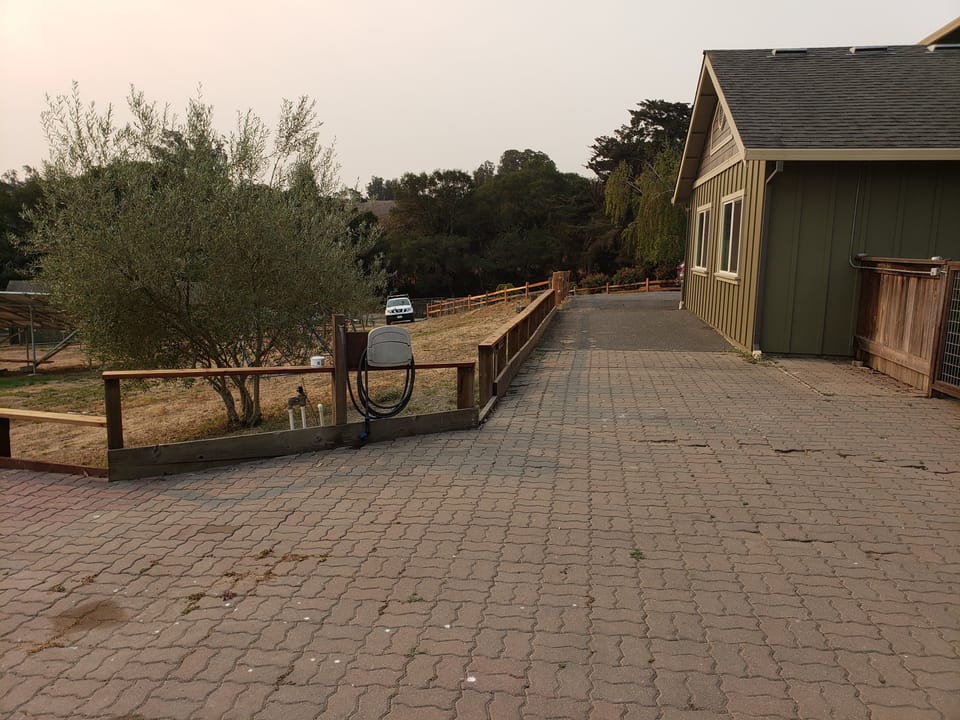
So what does 30 feet do? NIST says distance keeps the pile's own flames and heat off your walls. NIST saw steady flames reach more than 3 feet out from a burning pile. Distance does not stop embers, so NIST also says to make the house itself harder for embers to light. See what to fix on the house.
How far should firewood be from the house?
Find the band your woodpile sits in. The closer to the wall, the stricter the rules. IBHS, the Insurance Institute for Business and Home Safety, is an insurance industry research group whose home designation many insurers use. Where it and state law disagree, see Our take below.
- 0 to 5 feet: no firewood once the Board of Forestry rule takes effect. IBHS already says no. Until then, state law treats this strip like the rest of the first 30 feet.
- 5 to 30 feet: state law allows a pile here now only if it is fully covered with fire-resistant material. Otherwise it has to move past 30 feet. IBHS does not allow it at all, unless it is inside a shed that meets IBHS requirements.
- 30 to 100 feet (Zone 2): allowed. State law requires 10 feet of bare soil around the pile, on every side.
Our take: put it past 30 feet, and do not count on a tarp. State law accepts a covered pile closer in, but IBHS says fire-retardant tarps do not count. In NIST's one tarp test, the tarp did not burn, but flames opened holes in it and shrank it. Embers got out, and fires started about as fast as with no tarp. The proposed Board of Forestry rule would also change the 30-foot limit. The Board of Forestry says "covered" was unclear, so a pile 5 to 30 feet from the house would have to be completely enclosed in fire-resistant material, not just covered.
Does this apply to my home yet?
Partly. The 30-foot limit is law now. The 5-foot ban is not in force yet.
The 30-foot limit is in the defensible space rules for every building in a State Responsibility Area (SRA), mostly rural land where CAL FIRE handles wildfire. Fire inspectors check it now. In a city, ask your fire department whether it applies the same firewood limit. Check whether your address is covered.
The 5-foot ban is part of the Board of Forestry rule. The Board of Forestry pulled its August 2026 version back from state review on September 8, then adopted a revised rule on November 5, 2026. It still needs state approval before it can take effect. Check where the Board of Forestry rule stands now. Once it takes effect, existing homes get 3 years to clear firewood from the first 5 feet. Until then, the 30-foot limit still applies.
Some cities do not wait. San Diego, Berkeley, Auburn and South Lake Tahoe have their own Zone 0 rules. See local Zone 0 rules.
Where to put the woodpile
- Pick a spot at least 30 feet from the house. Measure from the outer edge of an attached deck if you have one. Keep it away from sheds and the neighbor's house too.
- Clear 10 feet around it. Rake down to bare soil on every side. That is the law for piles 30 to 100 feet out.
- No spot 30 feet away? NIST's first advice for keeping a woodpile is a closed box made of something that does not burn, such as steel, with the door facing away from buildings and kept shut. Ask your fire inspector whether yours counts as completely covered. Keep it out of the first 5 feet: IBHS bans it there, and so would the proposed Board of Forestry rule.
- Never stack it under a deck or stairs. State law already says to clear things that can burn from under decks and stairs. More on storing things under a deck.
- Clear the old spot. Bark, chips and leaves left where the pile stood can catch embers too. Why mulch by the wall is a problem.
To see all three zones for your own lot, try the defensible space calculator on Home Ready Sonoma, our sister site.
Common questions
- Does a rack or a small roof make it OK? No. In NIST's tests a rack made little difference, and state law asks for the pile to be completely covered, not just topped.
- Can I keep firewood in my shed? IBHS allows firewood inside a shed that meets its shed requirements, such as sitting at least 10 feet from the house. More on sheds near the house.
- What about the neighbor's woodpile? Embers do not stop at the fence. NIST recommends keeping woodpiles away from neighboring buildings too.
What insurers ask for now
IBHS Wildfire Prepared Home (WPH) is a home designation many California insurers use. WPH requires firewood at least 30 feet from the house, or inside a shed that meets its requirements. Fire-retardant tarps do not count. See how the lists differ.
Source: IBHS.
What to do instead
Stack it at least 30 feet from the house, with 10 feet of bare soil around the pile. That meets state law and WPH.
Timing: The 30-foot limit applies now where the defensible space law covers you. The 5-foot ban: new homes as soon as the Board of Forestry rule takes effect, existing homes within 3 years.
Source
- Revised Zone 0 rule text, November 5, 2026, California Board of Forestry and Fire Protection, November 5, 2026
- Notice of proposed emergency action: Zone 0 defensible space, California Board of Forestry and Fire Protection, August 20, 2026
- Recent actions taken on emergency regulations (file 2026-0828-03E, Zone 0 Defensible Space), California Office of Administrative Law, checked November 28, 2026
- Public Resources Code section 4291 (defensible space, including Zone 0), California Legislature, via Justia, checked October 19, 2026
- 14 CCR 1299.03: defensible space requirements, California Board of Forestry and Fire Protection, via Cornell Legal Information Institute, checked November 18, 2026
- Wind-driven fire spread to a structure from firewood piles (Technical Note 2251), National Institute of Standards and Technology (NIST), April 2023
- Wildfire Prepared Home: How-To Prepare Checklist, Insurance Institute for Business and Home Safety, checked November 19, 2026
- Notice of emergency action: Zone 0 defensible space (revised rule adopted November 5, 2026), California Board of Forestry and Fire Protection, November 5, 2026
Related questions
- Can I have bark mulch in Zone 0?
- Is gravel allowed in Zone 0?
- Are leaves and pine needles allowed in Zone 0?
- Can I have grass in Zone 0?
Want the whole picture? Take the free wildfire course.
Photos by Devan Hemmings unless noted.
Corrections
- November 7, 2026. An earlier version said existing homes would get no extra time to clear firewood from the first 5 feet. The rule text gives existing homes 3 years.