
Home / Is it allowed? / Plants against the house
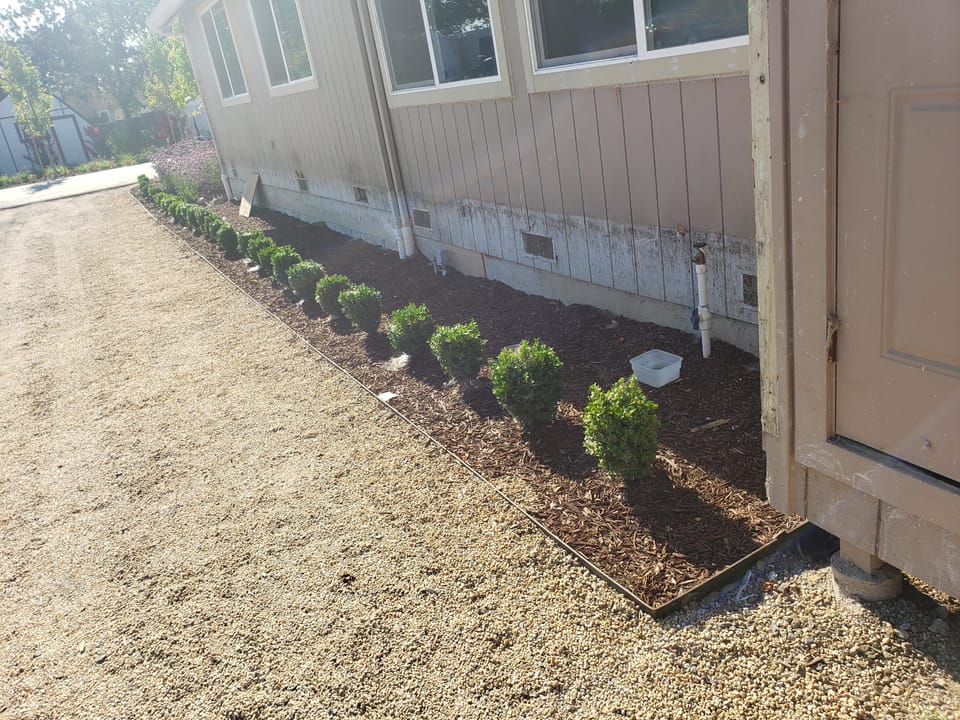
How far from the house do plants have to be?
Updated November 16, 2026
Not allowed under the Board of Forestry rule (proposed)This answer follows the Board of Forestry's Zone 0 rule as revised on November 5, 2026, which is not in force yet. Some items are already law, and some cities have their own rules. If so, it says so below.
Not allowed: plants within 1 foot of your walls, 2 feet of windows, doors and vents, or 5 feet of an attached deck, stairs or pergola. If your roof overhang (the eaves) sticks out more than 1 foot, the bare strip runs to its edge. That is the proposed Board of Forestry rule for Zone 0, the first 5 feet around a house.
The bare strips, from above
Red stays bare. Green can hold only low plants.
How much of the 5 feet is that?
Along 10 feet of plain wall, a fifth stays bare (20%). Add one 3-foot window and it is nearly a third (31%). Next to an attached deck, all of it. For a whole house, see how much of Zone 0 must stay plant-free.
Our calculation from the rule text distances, with 1-foot eaves. Method: we measured a 10 by 5 foot strip of ground on a fine grid.
Why these spots?
Embers, the burning bits wind carries ahead of a wildfire. The Board of Forestry says they are most likely to land in the first 5 feet, and the base of the wall, windows, decks and eaves are where a house catches most easily (Board summary).
What goes there instead?
- In the bare strips: gravel, rock, pavers, concrete or bare soil. Not bark or wood chips.
- In the rest of the 5 feet: only low plants with soft stems, like short lawn, small plants and pots. Shrubs go.
Our take: start with the strips. The Wildfire Prepared Home standard from the Insurance Institute for Business and Home Safety (IBHS) keeps them bare too, and goes further: no plants in the ground anywhere in the first 5 feet, even fire-resistant ones, though up to 10 plants under 3 feet tall can stay in clay or ceramic pots (IBHS checklist).
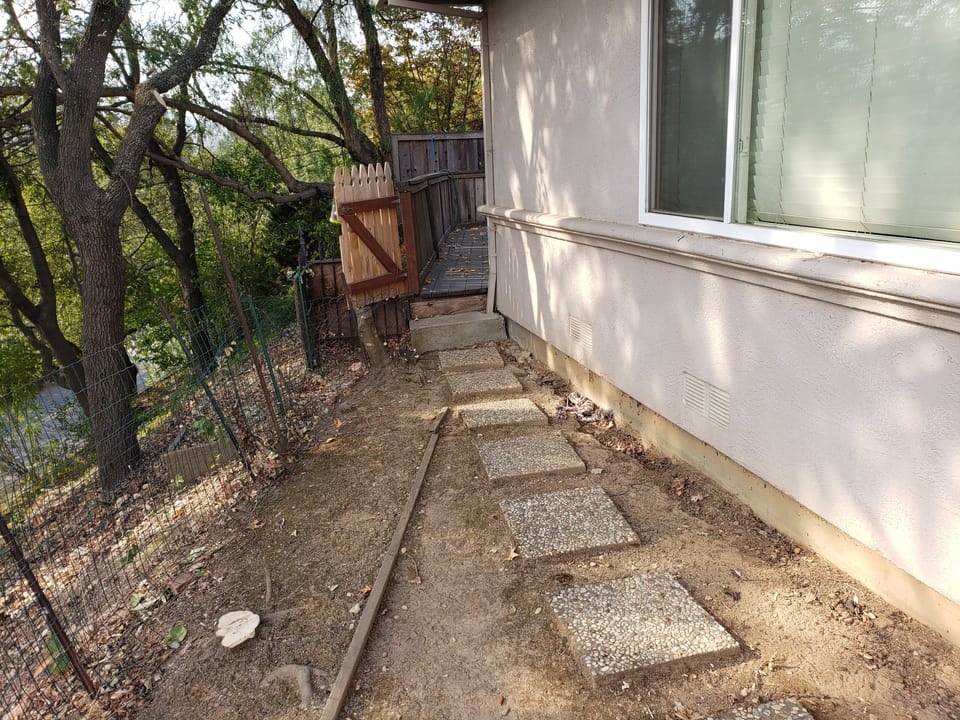
Insurers and the IBHS standard can ask for more than the Board of Forestry rule. See how they differ.
Timing: Once the Board of Forestry rule takes effect, existing homes get 3 to 5 years, on a schedule set by CAL FIRE or the local fire agency. New homes must meet it right away.
Source
- Revised Zone 0 rule text, November 5, 2026, California Board of Forestry and Fire Protection, November 5, 2026
- Zone 0 rule text dated August 19, 2026 (with the Board of Forestry's summary), California Board of Forestry and Fire Protection, posted by UC Agriculture and Natural Resources, checked November 16, 2026
- Wildfire Prepared Home: How-To Prepare Checklist, Insurance Institute for Business and Home Safety, checked November 19, 2026
Related questions
- Can I have bark mulch in Zone 0?
- Is gravel allowed in Zone 0?
- Can I store firewood next to my house?
- Are leaves and pine needles allowed in Zone 0?
Photos by Devan Hemmings unless noted.
Corrections
- October 29, 2026. The timing line gave only the schedule for Local Responsibility Areas (3 years, or up to 5). In a State Responsibility Area (where CAL FIRE is responsible for wildfires), the Board of Forestry's Zone 0 rule gives existing homes 5 years, or a CAL FIRE schedule of at least 3. It now says 3 to 5 years.