
Home / Is it allowed? / Sheds and outbuildings
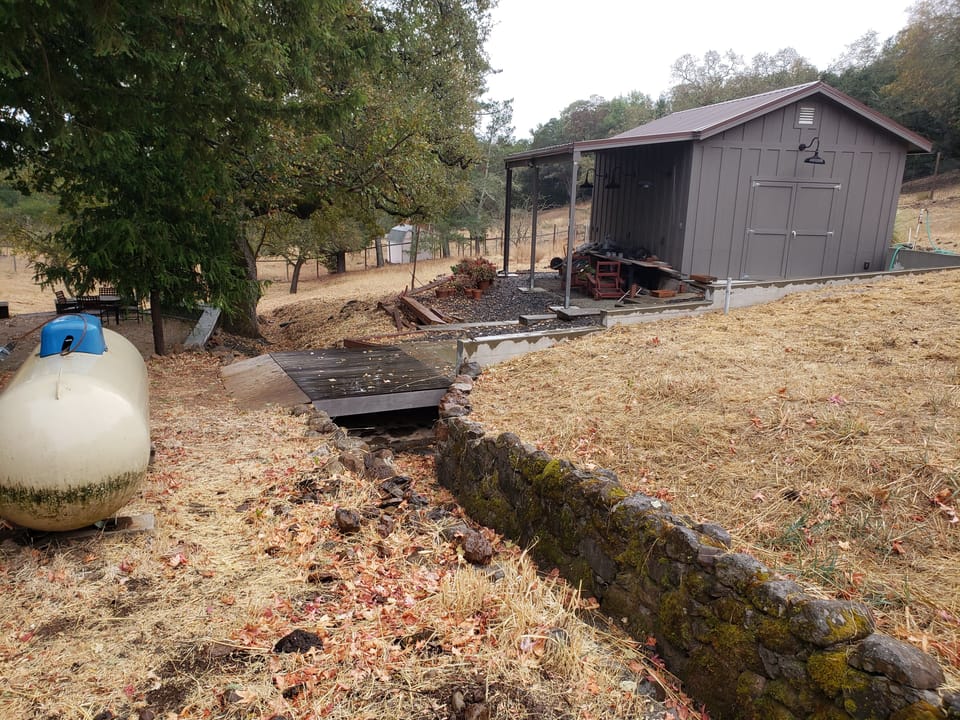
Can I keep a shed next to my house?
Updated October 24, 2026
Allowed, with limitsThis answer follows the Board of Forestry's Zone 0 rule as revised on November 5, 2026, which is not in force yet. Some items are already law, and some cities have their own rules. If so, it says so below.
Not within 5 feet, unless it is all metal or another material that does not burn. That is what the Board of Forestry rule says for the first 5 feet around a house. Federal fire tests say even that is too close: a burning shed needs at least 10 feet from a fire-resistant house wall if it is 26 square feet or less (about 5 by 5 feet), and 15 feet if it is up to 8 by 8 feet.
- Zone 0 is the first 5 feet out from the house, or up to the property line if that is closer.
- Materials that do not burn include metal and concrete. Wood, plastic and vinyl burn.
What a burning shed does to a house
A shed is a small building full of things that burn. If it catches fire, it is a fire right next to your house.
NIST, the federal standards lab, burned 13 sheds of wood and steel in front of a test wall with a window and a vented eave (the underside of the roof edge). Most tests used a big fan to push the flames toward the wall. NIST measured the heat reaching the eaves in kW/m² (kilowatts per square meter): the higher the number, the more heat hits the house. In the chart, compare the red bar (10 feet away) with the gray bars (15 feet away).
- Those distances are minimums. NIST's test wall was fire-resistant, built to California's WUI Code. A wall without that layer caught fire within 6 minutes from a very small wood shed 10 feet away. If your walls are not fire-resistant, or you are not sure, give the shed more room.
- Fuel makes it worse. NIST left out gas cans and propane for safety and warns they would likely break nearby windows. It did not test plastic sheds outdoors, and notes they melt and burn like a spreading pool. Treat a plastic shed like a wood one.
Is a metal shed safe in the first 5 feet?
The Board of Forestry rule would let an all-metal shed stay in the first 5 feet. NIST's tests say that is still too close. In the chart, compare the red bar with the wood shed bar below it.
- Metal helps, but the contents still burn. At 10 feet, a 4 by 5 foot steel shed gave off less than half the heat of a 5 by 5 wood shed.
- Turn the door away. Turning a steel shed's door to the side cut the heat about in half again.
How far should a shed be from the house?
Measure from the house wall (or the roof edge or deck, if they stick out farther) to the shed's closest corner, then find your band. IBHS, the Insurance Institute for Business and Home Safety, is an insurance industry research group. Its home designation has two levels: Essential, and the stricter Enhanced.
Our take: put a wood or plastic shed at least 15 feet from the house, even a small one. Burning wood sheds threw far more embers than metal ones in NIST's tests, and NIST says real yards need more room than its minimums. A metal shed up to about 5 by 5 feet can sit at 10 feet, a bigger one at 15, with the door facing away. Keep the same space from your neighbor's house.
Does this apply to my home yet?
Partly. The clearing around a shed is law now: 10 feet of bare soil, then no flammable plants for 10 more feet. It applies to sheds and other outbuildings in a State Responsibility Area (SRA), mostly rural land where CAL FIRE handles wildfire, under the defensible space rules. In a city, ask your fire department. Check whether your address is covered.
The 5-foot limit is part of the Board of Forestry rule, which the Board revised on November 5, 2026. It is not in force yet. Check where the Board of Forestry rule stands now. The rule covers outbuildings under 120 square feet that no one lives in. Our reading: a bigger building, like a detached garage, needs its own 5 feet.
Some cities have their own rules. In Auburn, a shed in the first 5 feet of a new home must be all noncombustible or built to the WUI Code. See local Zone 0 rules.
What to do with the shed you have
- Under 15 feet and made of wood or plastic? Plan to move it to 15 feet or more. Empty it first, and store gas cans and propane far from the house.
- Protect the base. IBHS asks for 6 inches of material that does not burn at the bottom of the walls, such as metal flashing, and nothing stored under a raised shed.
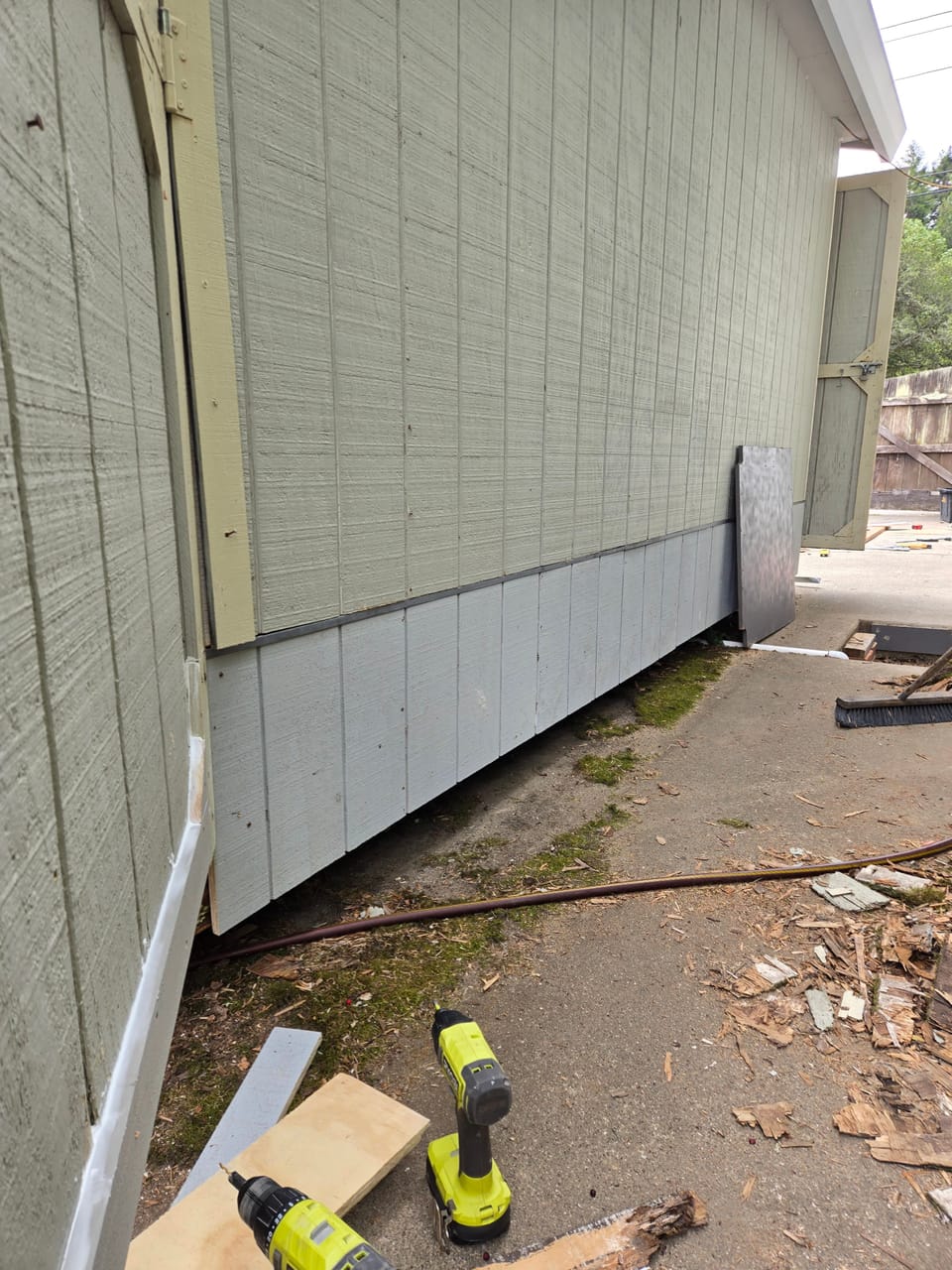
- Can't move it? Make the wall facing it harder to light. What to fix on siding and windows.
To see the defensible space zones on your own lot, try the defensible space calculator on Home Ready Sonoma, our sister site.
Common questions
- Does a metal shed with a wood floor count? Our reading: no. The rule text says entirely of materials that do not burn. Ask your fire inspector.
- Can I keep firewood in the shed? IBHS allows it in a shed that meets its shed requirements. More on firewood.
What insurers ask for now
IBHS Wildfire Prepared Home (WPH) is a home designation many California insurers use. Its Essential level wants any shed over 15 square feet within 30 feet at least 10 feet from the house, with a Class A roof (the top fire rating), its own clear 5 feet around it, and 6 inches of material that does not burn at the base of its walls. The Enhanced level wants every shed at least 30 feet away. See how the lists differ.
Source: IBHS.
What to do instead
Move a wood or plastic shed at least 15 feet out, or a small metal one 10 feet, door facing away. Clear 10 feet of bare soil around it.
Timing: The 10 feet of bare soil around a shed is law now where the defensible space law applies. The 5-foot limit: new homes as soon as the Board of Forestry rule takes effect; existing homes within 3 to 5 years, on a schedule set by CAL FIRE or the local fire agency.
Source
- Zone 0 rule text dated August 19, 2026 (with the Board of Forestry's summary), California Board of Forestry and Fire Protection, posted by UC Agriculture and Natural Resources, checked November 16, 2026
- Notice of proposed emergency action: Zone 0 defensible space, California Board of Forestry and Fire Protection, August 20, 2026
- Recent actions taken on emergency regulations (file 2026-0828-03E, Zone 0 Defensible Space), California Office of Administrative Law, checked November 28, 2026
- 14 CCR 1299.03: defensible space requirements, California Board of Forestry and Fire Protection, via Cornell Legal Information Institute, checked November 18, 2026
- NIST Outdoor Structure Separation Experiments (NOSSE) with Wind (Technical Note 2253), National Institute of Standards and Technology (NIST), May 2023
- Wildfire Prepared Home: How-To Prepare Checklist, Insurance Institute for Business and Home Safety, checked November 19, 2026
- State-mandated Zone Zero requirements set to go into effect to build wildfire resilience, City of San Diego, February 12, 2026
- EMBER implementation plan (City Council item, June 17, 2025), City of Berkeley, June 17, 2025
- Ember Resistant Zone requirements (Auburn Municipal Code 100.87, Subsection D), City of Auburn Fire Department, July 10, 2024
- Notice of emergency action: Zone 0 defensible space (revised rule adopted November 5, 2026), California Board of Forestry and Fire Protection, November 5, 2026
Related questions
- Can I have bark mulch in Zone 0?
- Is gravel allowed in Zone 0?
- Can I store firewood next to my house?
- Are leaves and pine needles allowed in Zone 0?
Photos by Devan Hemmings unless noted.
Corrections
- October 29, 2026. The timing line gave only the schedule for Local Responsibility Areas (3 years, or up to 5). In a State Responsibility Area (where CAL FIRE is responsible for wildfires), the Board of Forestry's Zone 0 rule gives existing homes 5 years, or a CAL FIRE schedule of at least 3. It now says 3 to 5 years.