
Home / Is it allowed? / Wood fence attached to the house
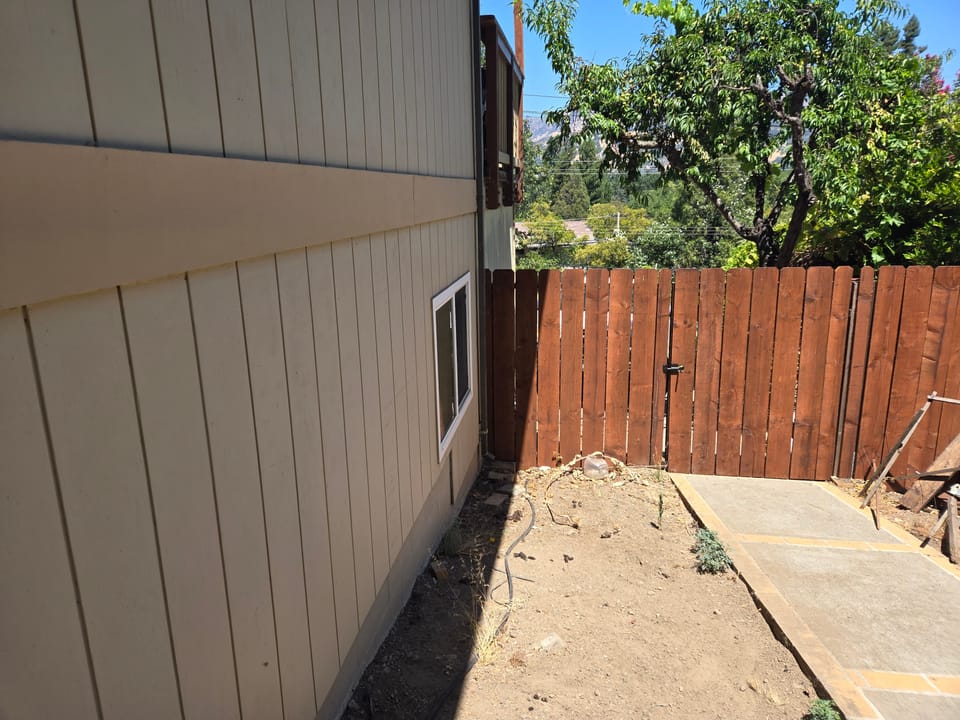
Do I have to replace my wood fence for Zone 0?
Updated November 7, 2026
Allowed, with limitsThis answer follows the Board of Forestry's Zone 0 rule as revised on November 5, 2026, which is not in force yet. Some items are already law, and some cities have their own rules. If so, it says so below.
No, not the whole fence. Zone 0 is the ground within 5 feet of your house. Under the proposed Board of Forestry rule, only the 5 feet of fence closest to your house, and any gate in that stretch, would have to be made of something that cannot burn, like metal. The rest of a wood fence can stay.
- This covers any fence or gate attached to the house, or one that comes within 1 foot of it.
- Building a new fence? Keep it noncombustible (made of something that cannot burn) within 5 feet of the house, including one that runs alongside the house.
- You can repair an existing wood fence with wood. The 5 feet at the house still has to change by your deadline.
Which part of the fence counts
Measure 5 feet from where the fence meets the house. Red must not burn. Gray can stay wood.
Why the 5 feet next to the house matter
A wood fence that touches your house works like a fuse. If it catches, it can carry fire right to the wall.
- Fences carry fire fast. The National Institute of Standards and Technology (NIST) is a federal lab. It ran 187 fire tests on fences and mulch, with a 13 to 31 mph wind blowing toward a small test building. NIST found that fences that can burn can carry fire fast to a building they touch or stand near (NIST).
- Mulch makes it worse. A wood fence alone burned slowly, mostly glowing. With mulch at its base, NIST rated it a high fire hazard.
- Burning fences throw embers. Embers are burning bits that the wind carries. In NIST's tests, embers from burning fences and mulch started new fires more than 155 feet away.
- It happens in real fires. After wildfires, the Insurance Institute for Business and Home Safety (IBHS), a nonprofit research group, found a burnable fence attached to a home that flames had reached. It could have carried fire straight to the house (IBHS).
After California wildfires, inspectors note where fire first caught on a home, when they can tell. The red bar is fences.
What counts as a material that cannot burn
Noncombustible means the material passed a standard lab fire test from California's building code. Find your fence material below.
| Fence material | OK for the 5 feet at the house? |
|---|---|
| Steel, aluminum, chain link, wrought iron | Yes |
| Concrete, concrete block | Yes |
| Wood, including redwood, cedar and pressure-treated | No |
| Vinyl or composite (wood and plastic) | No. IBHS says not to use them. NIST saw one composite fence flare up fast. |
| Wood with a fire-resistant coating | No. IBHS says not to use it. |
Sources: the Board of Forestry rule, IBHS and NIST.
Our take: do the posts and the gate too
The Board of Forestry rule asks for 5 feet of fence that cannot burn. It does not mention posts.
- Make the whole span metal or concrete, posts included. A metal panel bolted to a wood post still leaves wood against your wall. IBHS asks for posts and gates within 5 feet to be noncombustible too (IBHS checklist).
- Start with the gate. The Board of Forestry's own summary of its August 2026 draft gives this example: swap a wooden gate for a metal one (rule summary).
- Keep the base of the whole fence clear. Rake out mulch, dead leaves and needles.
See what else must change next to your walls: Can I have bark mulch in Zone 0? and Can I keep a shed next to my house?. In Sonoma County? Home Ready Sonoma, a related site, explains the local rules: Zone 0 rules in Sonoma County.
What insurers ask for now
IBHS Wildfire Prepared Home (WPH) is a home designation many California insurers use. WPH Essential and the FAIR Plan want fences and gates within 5 feet to be noncombustible. The Board of Forestry rule only needs the last 5 feet at the house to not burn. See how the lists differ.
Source: IBHS.
What to do instead
Swap the first 5 feet at the house, posts and gate included, for metal or concrete.
Timing: New fences or gates within 5 feet must not burn as soon as the Board of Forestry rule takes effect. For an existing fence at the house, existing homes get 3 to 5 years. Your local fire agency, or CAL FIRE, sets the date. New homes must meet it right away.
Source
- Revised Zone 0 rule text, November 5, 2026, California Board of Forestry and Fire Protection, November 5, 2026
- Zone 0 rule text dated August 19, 2026 (with the Board of Forestry's summary), California Board of Forestry and Fire Protection, posted by UC Agriculture and Natural Resources, checked November 16, 2026
- Notice of proposed emergency action: Zone 0 defensible space, California Board of Forestry and Fire Protection, August 20, 2026
- Fences and mulch: wind-driven fire spread to a structure, National Institute of Standards and Technology (NIST), checked November 1, 2026
- IBHS Research Center: field study findings (combustible fencing touching home), Insurance Institute for Business and Home Safety, checked November 1, 2026 (not an official source)
- Wildfire Prepared Home: How-To Prepare Checklist, Insurance Institute for Business and Home Safety, checked November 19, 2026
- CAL FIRE Damage Inspection (DINS) data, CAL FIRE, via data.gov, February 4, 2026
Related questions
- Can I have bark mulch in Zone 0?
- Is gravel allowed in Zone 0?
- Can I store firewood next to my house?
- Are leaves and pine needles allowed in Zone 0?
Want the whole picture? Take the free wildfire course.
Photos by Devan Hemmings unless noted.
Corrections
- November 1, 2026. This page said repairs can use noncombustible materials. The Board of Forestry's Zone 0 rule says repairs to an existing wood fence may use wood. It also covers fences that come within 1 foot of the house, not only ones attached to it. Both now match the Board of Forestry rule text.
- October 29, 2026. The timing line gave only the schedule for Local Responsibility Areas (3 years, or up to 5). In a State Responsibility Area (where CAL FIRE is responsible for wildfires), the Board of Forestry's Zone 0 rule gives existing homes 5 years, or a CAL FIRE schedule of at least 3. It now says 3 to 5 years.