
Home / Is it allowed? / Lawn and low ground cover
Can I have grass in Zone 0?
Updated November 18, 2026
Allowed, with limitsThis answer follows the Board of Forestry's Zone 0 rule as revised on November 5, 2026, which is not in force yet. Some items are already law, and some cities have their own rules. If so, it says so below.
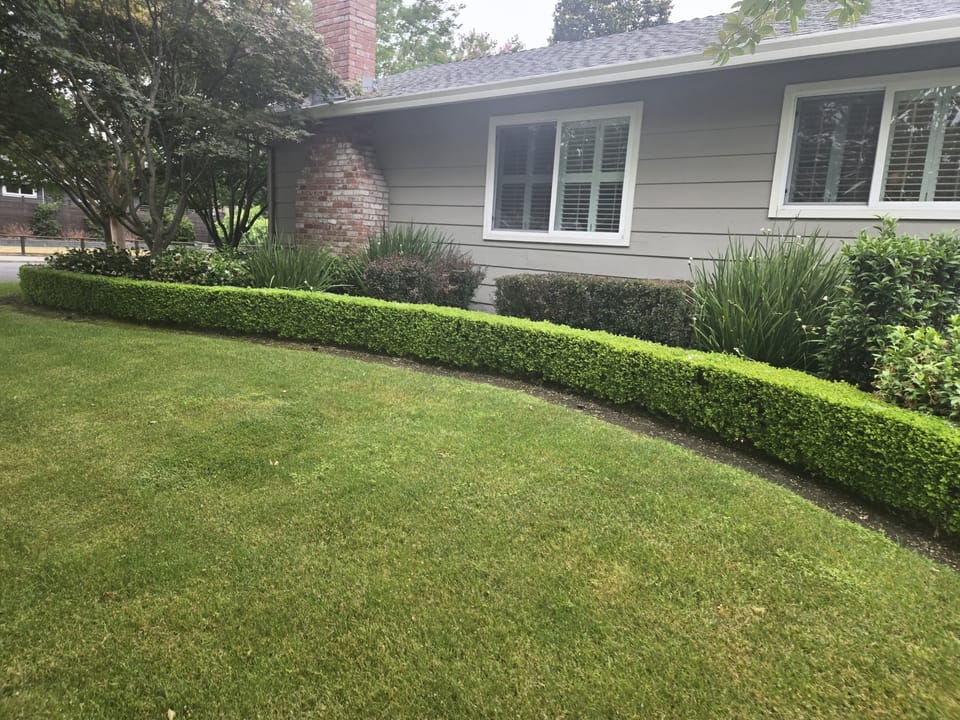
Lawn next to the house? It can stay if you keep it short. Under the proposed Board of Forestry rule, grass is allowed in Zone 0, the first 5 feet around a house, if it stays 3 inches tall or shorter, has nothing dead or dying in it, and stays out of a few bare strips next to the house.
Where does the lawn have to stop?
Not at the wall. These strips stay bare, with gravel, pavers, concrete or bare soil instead of grass:
- Along the walls: at least 1 foot, or out to the edge of the eaves (the part of the roof that hangs past the wall) if they stick out farther.
- Around windows, doors and vents: 2 feet out from each one.
- Around an attached deck, stairs or pergola (an open roof frame): 5 feet out from its edge, and nothing growing underneath.
Along a wall with no windows, doors or vents and 1-foot eaves, you keep 4 of the 5 feet for lawn (our reading of the rule text). See the bare strips drawn from above.
Will my mower setting keep it at or under 3 inches?
Probably. The limit is the grass's height, and grass grows between mowings. The chart uses mowing heights from the University of California (UC). Look at the right end of each bar.
Set the mower at 2 inches or lower, and mow before the grass passes 3. UC says to cut off no more than a third of the blade at a time, so grass cut at 2 inches needs mowing again by 3 (UC lawn guide). Every grass in the chart can be set that low.
Does brown grass count as dead?
The proposed Board of Forestry rule allows only grass "free of dead or dying" material. It does not say whether a lawn gone brown in a dry summer counts.
Our take: treat brown grass as dead. Keep the lawn in the first 5 feet watered and green through fire season, or swap the brown patches for gravel.
Where CAL FIRE handles wildfire, dead grass within 30 feet of a house is already against state law (defensible space rules). Check who covers your address.
What about clover, moss or artificial turf?
- Clover, moss and other soft-stemmed ground covers: same limits as grass. For taller plants, see what plants are allowed in Zone 0.
- Artificial turf: our reading is no. The proposed Board of Forestry rule does not name it, but it bans plastic items and other materials that burn in Zone 0 (rule text). See what ground covers work instead.
Does Wildfire Prepared Home allow a lawn?
No. Wildfire Prepared Home is a designation from the Insurance Institute for Business and Home Safety (IBHS). It asks for no plants in the ground at all in the first 5 feet, grass included, even if watered (IBHS checklist). It also rules out artificial turf there. From 5 to 30 feet, it asks for grass under 4 inches.
Our take: if you plan to apply for Wildfire Prepared Home, pull the lawn back to 5 feet now and put gravel against the house. What it can mean for your policy: Zone 0 and home insurance.
Insurers and the IBHS standard can ask for more than the Board of Forestry rule. See how they differ.
Timing: Once the Board of Forestry rule takes effect, existing homes get 3 to 5 years, on a schedule set by CAL FIRE or the local fire agency. New homes must meet it right away.
Source
- Revised Zone 0 rule text, November 5, 2026, California Board of Forestry and Fire Protection, November 5, 2026
- Lawn mowing heights (Proper Mowing Heights and Mowers for California Turfgrass), UC Cooperative Extension Ventura County, checked November 18, 2026
- UC Guide to Healthy Lawns: how much, when, and how often to mow, UC Statewide Integrated Pest Management Program, checked November 18, 2026
- 14 CCR 1299.03: defensible space requirements, California Board of Forestry and Fire Protection, via Cornell Legal Information Institute, checked November 18, 2026
- Wildfire Prepared Home: How-To Prepare Checklist, Insurance Institute for Business and Home Safety, checked November 19, 2026
Related questions
- Can I have bark mulch in Zone 0?
- Is gravel allowed in Zone 0?
- Can I store firewood next to my house?
- Are leaves and pine needles allowed in Zone 0?
Photos by Devan Hemmings unless noted.
Corrections
- October 29, 2026. The timing line gave only the schedule for Local Responsibility Areas (3 years, or up to 5). In a State Responsibility Area (where CAL FIRE is responsible for wildfires), the Board of Forestry's Zone 0 rule gives existing homes 5 years, or a CAL FIRE schedule of at least 3. It now says 3 to 5 years.