
Home / Is it allowed? / Small plants (3 to 18 inches)
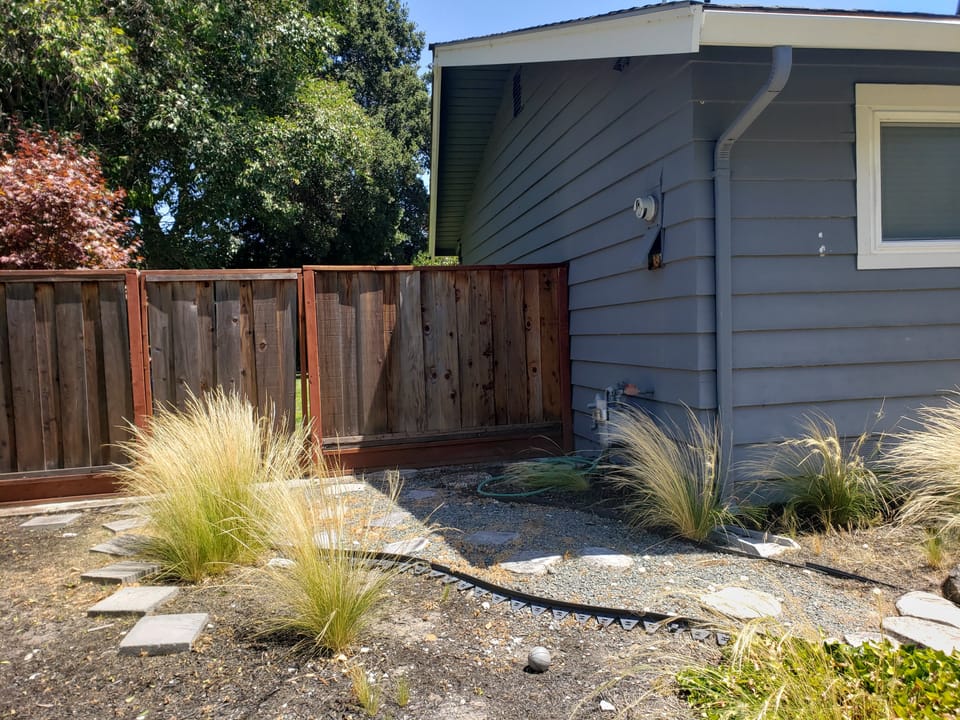
What plants are allowed in Zone 0?
Updated November 7, 2026
Allowed, with limitsThis answer follows the Board of Forestry's Zone 0 rule as revised on November 5, 2026, which is not in force yet. Some items are already law, and some cities have their own rules. If so, it says so below.
Want flowers next to your house? Zone 0 is the first 5 feet around it. Under the Board of Forestry's Zone 0 rule, low plants with soft green stems can stay there. Short ground covers can fill the space. Flowers and grasses up to 18 inches tall go in small clumps with gaps between them.
- Soft green stems means no woody stems or trunks. Annuals, perennials, bulbs, grasses, ferns, mosses and some succulents count.
- If your property line is closer than 5 feet, Zone 0 stops at the line.
Which plants can stay?
The Board of Forestry rule sorts plants by how tall they grow. Find your plant's height below, then read its limit.
- Up to 3 inches: as much as you like. Lawn, and ground covers such as blue-star creeper, beach strawberry, creeping thyme and moss. Keep them green, with no dead leaves. More: Lawn in Zone 0.
- 3 to 18 inches: small clumps with gaps. Each clump covers 1 square foot or less, about the size of a floor tile. Leave at least 2 feet between clumps, measured from the plants' widest points. Examples: bulbs, impatiens, begonias, petunias, poppies, yarrow, and succulents that do not build up a layer of dead leaves underneath.
- In pots: soft-stemmed plants up to 18 inches tall. Use loose pots, not fixed in place, that cannot burn, like ceramic or metal, 5 gallons or smaller. Space them at least 2 feet apart. More: Potted plants in Zone 0.
- Not allowed: shrubs and other woody plants, soft-stemmed plants over 18 inches, and new trees. More: What to do with shrubs. Existing trees can stay if kept trimmed. More: Trees near the house.
Plant examples come from the state Board of Forestry's summary of the rule. The Board wrote the rule.
Where can they go?
Not right against the house. The strip closest to the wall stays bare. It protects the parts of a house that catch fire most easily: the base of the wall, windows, doors, vents and eaves (the edge of the roof that hangs out past the wall). In the drawing, gray means no plants and green means low plants are OK.
An attached deck, stairs or pergola needs 5 feet with no plants around it. More: The plant-free strips.
How many plants fit?
Each clump needs 2 feet of space around it, so few fit. We worked out how many fit on a simple grid along 10 feet of plain wall with no doors, windows or vents.
Deeper eaves leave less room. With eaves that stick out 3 feet, 4 clumps fit on the same grid. Doors, windows and vents leave room for fewer still.
Does this apply to my home yet?
Partly.
- Today: pull dead plants. Where the state (CAL FIRE) is responsible for wildfires, the defensible space law already requires clearing dead plants, grass and weeds within 30 feet of a house, which includes the first 5 feet. In Very High fire hazard zones in Local Responsibility Areas, state law requires defensible space and keeping plants next to the house free of dead wood. Check whether your address is covered.
- Today, where CAL FIRE is responsible: clear plants next to and under wooden decks, balconies and stairs. The defensible space law already requires it.
- Later: the size and spacing limits above. They come from the Board of Forestry rule, which is not in force yet. The Board's summary says existing homes get 3 years for plants; we follow the rule text, which allows up to 5. Check where the Board of Forestry rule stands now.
Some cities already limit plants in the first 5 feet, such as two hillside areas of Berkeley. See local Zone 0 rules.
How much should you plant?
Our take: plant less than the rule allows, and put plants near the outer edge of the 5 feet. IBHS, an insurance industry research group, ran fire tests with burning stacks of wood in place of plants. At 3 feet from a test wall, the wall heated to about 390°F, the hazard line IBHS used. At 5 feet, it stayed below that. The tests used stacks of wood, not low plants, but they show that distance from the wall matters. Short ground covers are the easiest choice: no gaps, no clumps to count. More: Lawn in Zone 0.
What to do this fall
- Pull dead plants, spent flowers and fallen leaves from the first 5 feet.
- Mark the bare strip shown in the drawing above. Add 5 feet around an attached deck, stairs or pergola.
- Move shrubs and soft-stemmed plants taller than 18 inches out past 5 feet. Existing trees can stay if trimmed.
- Replant between the bare strip and the 5-foot line with ground cover or a few spaced clumps. Keep them watered and trimmed.
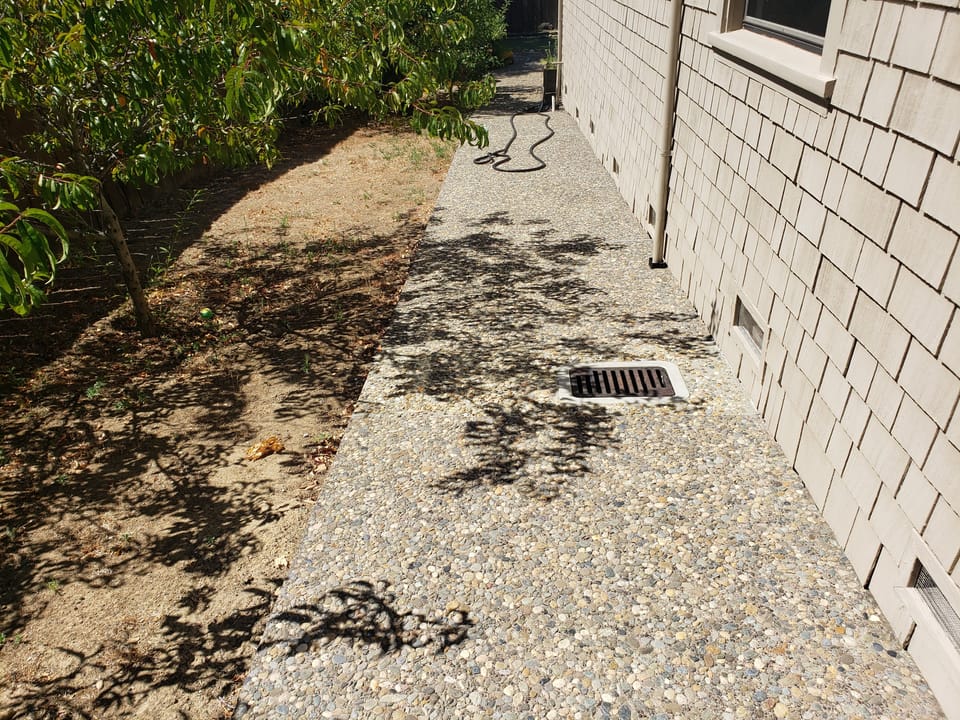
Can I grow vegetables or herbs there?
Our reading: soft-stemmed ones under 18 inches, like lettuce, follow the clump limits. Plants that grow taller than 18 inches, like tomatoes, do not fit, and woody herbs like rosemary count as shrubs.
What insurers ask for now
IBHS Wildfire Prepared Home (WPH) is a home designation many California insurers use. WPH wants no plants at all in the first 5 feet. The FAIR Plan also lists vegetation to be cleared within 5 feet. The Board of Forestry rule lets some low plants stay. See how the lists differ.
Source: IBHS.
Timing: Plants in the first 5 feet: once the Board of Forestry rule takes effect, existing homes get 3 to 5 years, on a schedule set by CAL FIRE or the local fire agency. New homes must meet it right away.
Source
- Revised Zone 0 rule text, November 5, 2026, California Board of Forestry and Fire Protection, November 5, 2026
- Zone 0 rule text dated August 19, 2026 (with the Board of Forestry's summary), California Board of Forestry and Fire Protection, posted by UC Agriculture and Natural Resources, checked November 16, 2026
- Notice of proposed emergency action: Zone 0 defensible space, California Board of Forestry and Fire Protection, August 20, 2026
- 14 CCR 1299.03: defensible space requirements, California Board of Forestry and Fire Protection, via Cornell Legal Information Institute, checked November 18, 2026
- Government Code section 51182 (defensible space in Very High fire hazard zones in Local Responsibility Areas), California Legislature, via Justia, checked October 19, 2026
- Near-Building Noncombustible Zone technical report (December 2018), Insurance Institute for Business and Home Safety (IBHS), checked October 31, 2026 (not an official source)
- Wildfire Prepared Home: How-To Prepare Checklist, Insurance Institute for Business and Home Safety, checked November 19, 2026
- EMBER implementation plan (City Council item, June 17, 2025), City of Berkeley, June 17, 2025
Related questions
- Can I have bark mulch in Zone 0?
- Is gravel allowed in Zone 0?
- Can I store firewood next to my house?
- Are leaves and pine needles allowed in Zone 0?
Want the whole picture? Take the free wildfire course.
Photos by Devan Hemmings unless noted.
Corrections
- October 29, 2026. An earlier version said each planting must be under 1 square foot. The Board of Forestry's Zone 0 rule allows plantings of 1 square foot or less. The timing line gave only the schedule for Local Responsibility Areas (3 years, or up to 5). In a State Responsibility Area (where CAL FIRE is responsible for wildfires), the Board of Forestry rule gives existing homes 5 years, or a CAL FIRE schedule of at least 3. It now says 3 to 5 years.