
Home / Is it allowed? / Shrubs and woody plants
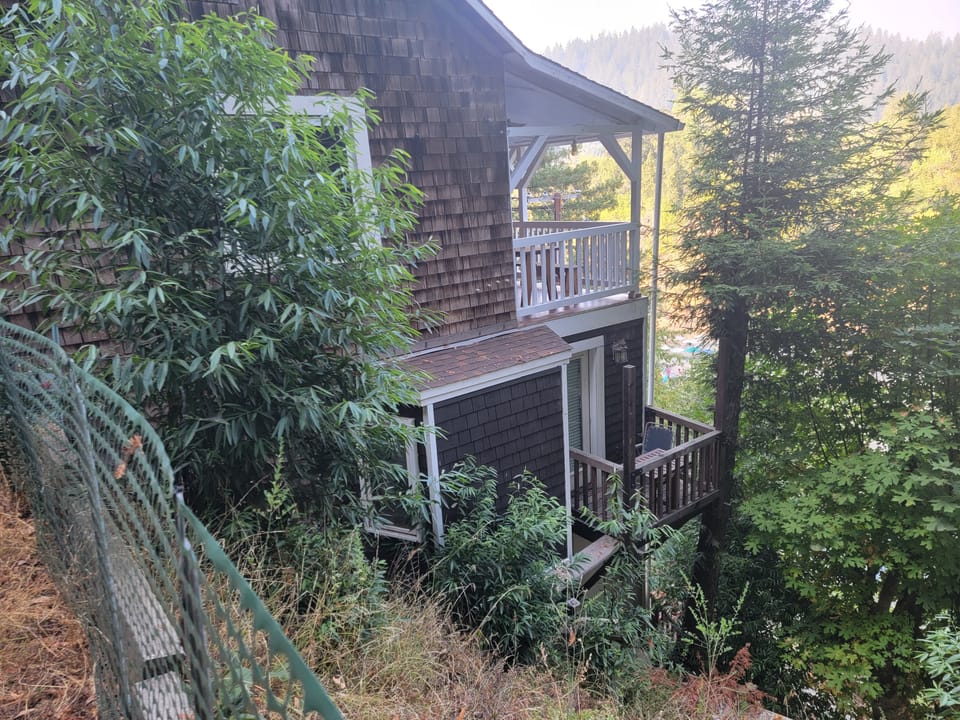
Can I keep shrubs within 5 feet of my house?
Updated October 27, 2026
Not allowed under the Board of Forestry rule (proposed)This answer follows the Board of Forestry's Zone 0 rule as revised on November 5, 2026, which is not in force yet. Some items are already law, and some cities have their own rules. If so, it says so below.
Many homes have shrubs right against the walls: a hedge under a window, a rosemary by the door. Under the proposed Board of Forestry rule, they could not stay in the first 5 feet around the house, called Zone 0. Only low plants with soft green stems would be allowed there. In federal fire tests, a dried fir tree the size of a shrub burned with flames about 13 feet tall.
- If your property line is closer than 5 feet, Zone 0 stops at the line.
- Woody plants have hard stems or trunks. Most shrubs and hedges are woody, such as roses, juniper, boxwood and manzanita.
Does this apply to my home yet?
Partly. State law already requires dead or dying shrubs, and dead branches over the roof or next to walls and windows, to be removed within 30 feet of a house. That is Zone 1 of the defensible space rules. It applies now in a State Responsibility Area, mostly rural land where CAL FIRE handles wildfire, and in Very High fire hazard zones in Local Responsibility Areas, where a city or county handles wildfire (Gov. Code 51182). Check whether your address is covered.
Healthy shrubs in the first 5 feet can stay for now under state law, except next to or under a wooden deck where the defensible space law applies. The Board of Forestry rule would remove them, but it is not in force yet. Check where the Board of Forestry rule stands now.
Some cities already limit plants in the first 5 feet, such as two hillside areas of Berkeley. See local Zone 0 rules.
How big a fire can one shrub make?
A shrub is a tight bundle of twigs, leaves and dead wood. If embers light it, it burns fast and tall, right against your wall or under a window.
NIST, the federal standards lab, cut small Douglas-fir trees, let them dry, and burned them indoors. They were sold as 4, 8 and 12 feet tall, about the size of large shrubs. In the chart, compare each gray bar (the height of the branches) with the red bar under it (the height of the flames, measured up from the lowest branch).
Why 5 feet? IBHS, an insurance industry research group, ran fire tests with burning stacks of wood standing in for plants next to a test wall, with fans blowing wind at it. At 3 feet the wall reached about 390°F, the danger line IBHS used. At 5 feet it stayed below that line. At a corner of the building facing the wind, it took 7 feet to stay well below it.
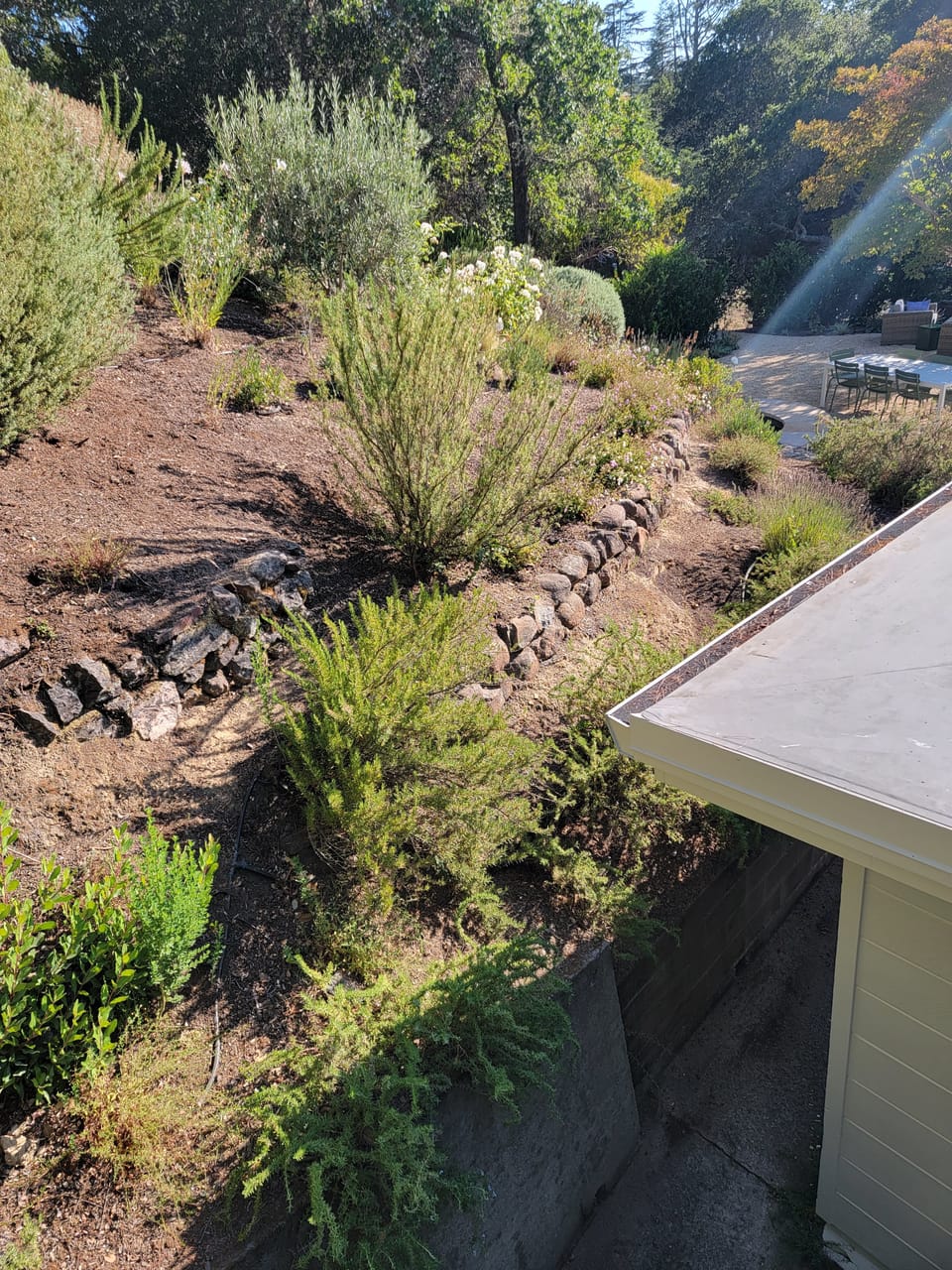
What to do with the shrubs you have
- Measure 5 feet out from the wall, or from the edge of an attached deck.
- Clear dead shrubs and dead branches first.
- Next, clear the plant-free spots: within 1 foot of the wall, under the roof edge (the eaves), within 2 feet of windows, doors and vents, and within 5 feet of an attached deck, stairs or pergola. In those spots the Board of Forestry rule allows no plants at all, not even low ones. See the plant-free strips.
- Then move or replace the rest of the first 5 feet. Gravel, pavers or bare soil work. A few low, soft-stemmed plants can go where the rule allows them. Which low plants are allowed.
Our take: replant shrubs at least 10 feet from the house. IBHS allows spaced shrubs between 5 and 10 feet. In NIST's burns, flames reached 1.5 to 3 times the height of the branches, so we would give the house more room.
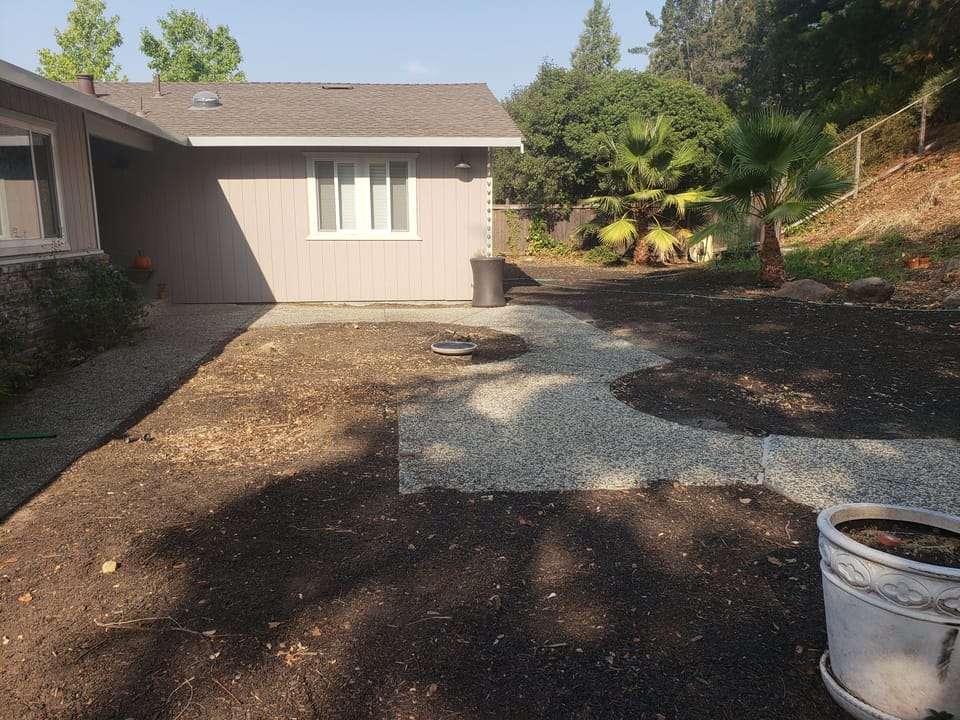
Where can shrubs go?
Find your distance from the house in the bands below. Each band shows the Board of Forestry rule, state law now, and Wildfire Prepared Home, the IBHS home designation for wildfire.
How far apart should shrubs be?
Past the first 5 feet, shrubs can stay, but not as one solid mass. Gaps keep fire from moving plant to plant toward the house. CAL FIRE recommends a gap based on the shrub's height and the slope of the ground. Slope is how much the ground rises: a 20% slope rises 2 feet for every 10 feet across. Find your shrub's height on the left and read across to your slope.
Our take: use the CAL FIRE table above. IBHS asks for a gap of 2 times the shrub's height, capped at 10 feet. That matches the flat-ground column for shrubs up to 5 feet tall. On slopes CAL FIRE asks for more room, so we follow CAL FIRE.
To see the defensible space zones on your own lot, try the defensible space calculator on Home Ready Sonoma, our sister site.
Common questions
- Do rosemary and lavender count as woody? Our reading: yes. The Board of Forestry rule allows only plants without hardened stems, and both grow hard, woody stems at the base. Ask your fire inspector if you are not sure.
- What if my shrub has grown as big as a tree? The rule calls a woody plant a tree if it grows at least 15 feet tall, with a trunk at least 4 inches thick at 4.5 feet up. Existing trees can stay in the first 5 feet if they are kept trimmed. Our reading: a shrub that big counts as a tree. How to keep a tree near the house.
What insurers ask for now
IBHS Wildfire Prepared Home (WPH) is a home designation many California insurers use. WPH wants no plants at all in the first 5 feet, shrubs included, even if they are watered or labeled fire-resistant. See how the lists differ.
Source: IBHS.
What to do instead
Take shrubs out of the first 5 feet. Replant them 10 feet out or more, with gaps between them.
Timing: Live shrubs in the first 5 feet: once the Board of Forestry rule takes effect, existing homes get 3 to 5 years, on a schedule set by CAL FIRE or the local fire agency.
Source
- Zone 0 rule text dated August 19, 2026 (with the Board of Forestry's summary), California Board of Forestry and Fire Protection, posted by UC Agriculture and Natural Resources, checked November 16, 2026
- Notice of proposed emergency action: Zone 0 defensible space, California Board of Forestry and Fire Protection, August 20, 2026
- 14 CCR 1299.03: defensible space requirements, California Board of Forestry and Fire Protection, via Cornell Legal Information Institute, checked November 18, 2026
- Public Resources Code section 4291 (defensible space, including Zone 0), California Legislature, via Justia, checked October 19, 2026
- Government Code section 51182 (defensible space in Very High fire hazard zones in Local Responsibility Areas), California Legislature, via Justia, checked October 19, 2026
- Ignition of structures by burning vegetation (NISTIR 7179, October 2004), Douglas-fir tree burns, National Institute of Standards and Technology, checked October 27, 2026
- Near-Building Noncombustible Zone technical report (December 2018), Insurance Institute for Business and Home Safety (IBHS), checked October 31, 2026 (not an official source)
- Defensible space: how to space trees and shrubs, CAL FIRE, checked October 27, 2026
- Wildfire Prepared Home: How-To Prepare Checklist, Insurance Institute for Business and Home Safety, checked November 19, 2026
- EMBER implementation plan (City Council item, June 17, 2025), City of Berkeley, June 17, 2025
Related questions
- Can I have bark mulch in Zone 0?
- Is gravel allowed in Zone 0?
- Can I store firewood next to my house?
- Are leaves and pine needles allowed in Zone 0?
Want the whole picture? Take the free wildfire course.
Photos by Devan Hemmings unless noted.